
If you’ve been researching retrofit underfloor heating, chances are you’ve come across a lot of conflicting information.
Some homeowners worry about running costs. Others assume underfloor heating will massively raise floor height or only works in new builds. Many people renovating older UK homes are simply unsure whether it’s even possible in their property.
As specialists in precision-milled retrofit underfloor heating, these are exactly the questions we answer every day on renovation projects across the UK.
At Channel Heat Systems we regularly work in:
- older UK homes
- 1930s properties
- Victorian renovations
- glazed kitchen extensions
- open-plan remodels
- partial renovations
- homes preparing for heat pumps
and homeowners are often surprised by just how practical modern retrofit underfloor heating systems have become.
This guide brings together some of the most common homeowner questions we receive – from underfloor heating running costs and renovation timing to floor build-up, installation times and when underfloor heating may or may not be the right solution.
Quick Answers
- Retrofit underfloor heating is usually cheaper to run than radiators because it operates at lower temperatures.
- Channel-cut systems can often be installed with minimal floor height increase.
- Renovation projects are usually the best time to install underfloor heating.
- Most retrofit installations are completed within 1–2 days.
- Existing homes and older properties can still benefit significantly from retrofit underfloor heating.
Is retrofit underfloor heating actually cheaper to run than radiators?
In most real-world situations, the answer is yes: wet underfloor heating systems are typically more energy efficient and cheaper to run than traditional radiators.
The main reason is that underfloor heating works at a much lower flow temperature while still delivering a comfortable level of heat throughout the room.
Traditional radiators mainly heat through convection. They create concentrated hot areas around the radiator itself, with much of the heat rising toward the ceiling before circulating around the space. Underfloor heating works differently. It provides a more even radiant heat from the floor upwards, which means many homeowners feel comfortable at lower room temperatures compared to radiator systems.
This is one of the biggest reasons retrofit underfloor heating for existing homes has become increasingly popular, especially alongside:
- Air source heat pumps
- Low-temperature heating systems
- Modern renovation projects
- Open-plan living spaces
One of the biggest things homeowners notice is not simply energy usage, it’s comfort.
We regularly work in properties where homeowners tell us:
- “The room never felt warm enough”
- “The radiator was always on”
- “There were cold spots everywhere”
- “The extension always felt colder than the rest of the house”
We recently worked on a glazed kitchen extension where the homeowners had oversized radiators but still struggled with uneven temperatures throughout the room.
After installing a properly designed retrofit wet underfloor heating system, the heat distribution became far more balanced and comfortable across the entire space.
Does insulation matter?
Yes, insulation always helps improve the efficiency of any heating system. A well-insulated home will naturally retain heat more effectively and require less overall energy to maintain comfortable temperatures.
However, one of the biggest misconceptions we hear is that retrofit underfloor heating “won’t work” in older or less insulated homes because “all the heat will disappear into the floor.”
In reality, heat loss exists in any property regardless of whether the heating comes from radiators or underfloor heating. If a house loses heat through glazing, draughts, roofs, open fireplaces or poorly insulated walls, those losses still exist with traditional radiators as well.
Interestingly, homeowners are rarely warned about “heat loss” when installing standard radiators, yet the same property suddenly becomes “a problem” the moment underfloor heating is mentioned. In practice, many of the biggest heat losses in UK homes come from:
• Glazing and large windows
• Draughts
• Roofs and loft spaces
• Thermal bridges
• Open fireplaces and chimneys
Many people assume huge amounts of heat immediately disappear downward into the floor itself, but from our real-world installation experience this is often far less significant than homeowners imagine, particularly in existing screed and concrete floors which can also help act as thermal mass and distribute warmth more evenly across the space.
One of the biggest differences homeowners notice is not simply energy usage, but overall comfort. Traditional radiators mainly create concentrated hot areas around the radiator itself, with heat rising upward and circulating around the room. Underfloor heating creates a far more even radiant heat across the floor surface, which often allows homeowners to feel comfortable at lower room temperatures.
We regularly work in older UK homes and glazed kitchen extensions where homeowners previously struggled with:
• Cold spots
• Uneven temperatures
• Uncomfortable rooms
• Radiators constantly running
• High heating bills
After installing a properly designed retrofit wet underfloor heating system, many clients are genuinely surprised by how much more comfortable and balanced the heating feels throughout the property.
So while insulation upgrades are always beneficial where possible, a lack of perfect insulation does not automatically mean retrofit underfloor heating is unsuitable for an existing home.
Does retrofit underfloor heating respond slowly?
Not necessarily.
One major advantage of channel-cut underfloor heating systems is that the pipework sits much closer to the finished floor surface compared to traditional deep screed systems.
In many projects, homeowners can begin feeling warmth within around 20–30 minutes rather than waiting many hours for a thick screed slab to fully heat up.
Floor finish also matters:
- Tiles and LVT usually provide the fastest response times
- Timber and thicker carpets can slow heat transfer slightly
- However, underfloor heating can still work successfully with many floor finishes when designed correctly
Overall, retrofit underfloor heating combines:
- Lower running temperatures
- More even heat distribution
- Improved comfort
- Compatibility with heat pumps
- Faster response times
which is why many homeowners find it noticeably more comfortable and economical than radiators.
Is a renovation the best time to install retrofit underfloor heating?
In most cases, yes – renovation projects are the ideal time to install retrofit underfloor heating.
If floors are already being replaced, lifted or reworked, it often makes far more sense to install underfloor heating during the renovation rather than revisit the project later.
Once final floor finishes such as tile, LVT, engineered wood or glued flooring have been installed, going back later can create significant additional cost, disruption and waste.
This is especially true in kitchen renovations, rear extensions, open-plan remodels and partial ground floor renovations.
Having a renovation and wondering if retrofitting underfloor heating is feasible in your property? Chat to our expert to get a no-obligation advice.
Why homeowners choose retrofit systems during renovations
Many homeowners now see underfloor heating as a form of future-proofing.
With increasing focus on low-temperature heating, energy-efficient homes and heat pump compatibility, installing underfloor heating during a renovation means the property is already prepared for future heating upgrades.
There are also major practical benefits:
- More freedom with furniture placement
- No bulky wall radiators
- Cleaner room layouts
- Greater design flexibility in kitchens and open-plan spaces
Will retrofit underfloor heating raise my floor height?
This is one of the biggest concerns homeowners have, especially in UK renovation projects where doors, thresholds, skirting boards, staircases, kitchen units or ceiling heights already create tight tolerances.
The honest answer is that some traditional overlay systems can noticeably raise the floor level.
However, channel-cut retrofit underfloor heating works very differently.
How channel-cut underfloor heating reduces floor build-up
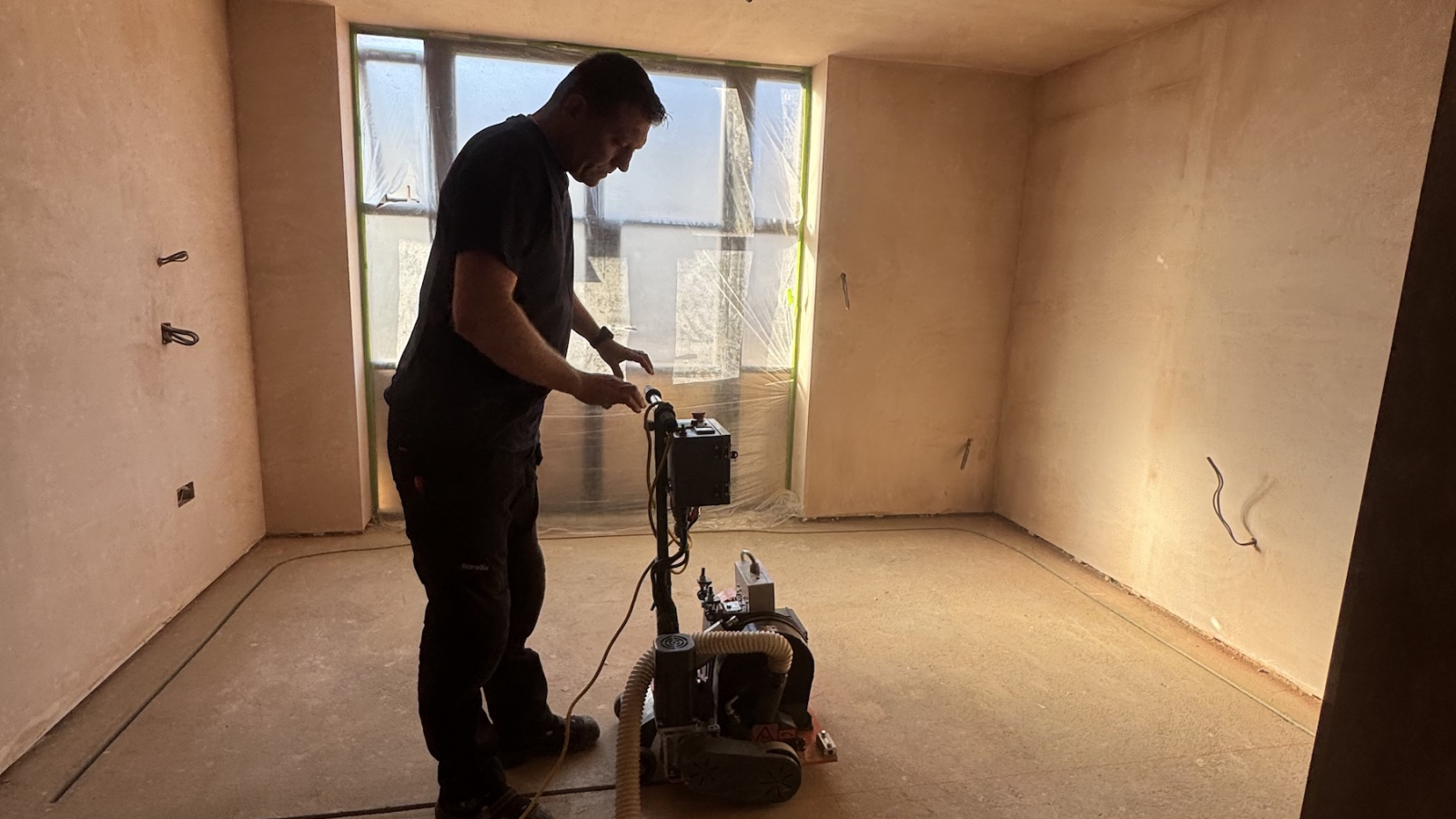
With our retrofit approach, we precision mill channels directly into the existing screed or concrete floor and install the pipework within the floor itself rather than building a thick new layer on top.
This allows us to start from the existing floor level rather than heavily increasing it.
What we see on-site:
- Only around 4–5 mm of levelling compound may be required
- Rougher renovation floors may approach around 10 mm overall
- Still significantly less than many overlay systems
We often work in homes where preserving floor levels is critical because homeowners are trying to avoid trimming doors, altering bifold thresholds, changing staircase heights, removing fitted kitchens, awkward transitions between rooms or reducing already low ceiling heights,
Many of our clients are genuinely surprised when they discover that retrofit underfloor heating without floor build-up is actually possible.
How long does retrofit underfloor heating installation take?
One of the biggest misconceptions around underfloor heating is that installation takes weeks and completely disrupts the property.
In reality, most retrofit underfloor heating installations are completed surprisingly quickly.
Typical installation times we aim for at Channel Heat Systems:
- Smaller projects: sometimes completed within a single day
- Medium renovations: often 1–2 days
- Larger projects: several days depending on floor size and construction
And what affects installation time?
The biggest factor is usually the existing floor material.
Standard screed floors are typically faster to cut than extremely hard concrete slabs, which can slow the milling process and increase tool wear.
However, even in larger projects, retrofit systems are usually far quicker and cleaner than homeowners initially expect.
Can other trades continue working during the underfloor heating installation process?
Absolutely yes, and this is one of the biggest advantages during renovations.
Our teams regularly work alongside builders, electricians, plumbers, floor fitters and kitchen installers while other renovation works continue elsewhere in the property.
In many cases:
- Homeowners remain living in the house
- Tilers can start shortly after installation
- Final plumbing connections happen later
- Disruption is kept to a minimum
Most delays are actually caused by, for example, unfinished floor preparation, poor site access, furniture not being removed or damaged existing floor rather than the heating installation itself.
When would underfloor heating NOT be the right choice?
This is something homeowners rarely hear installers discuss honestly, but there are situations where we would genuinely advise caution.
For example:
- Some suspended timber floors may require significant preparation
- Properties with severe insulation issues may benefit from insulation upgrades first
- Very small renovation areas may not always justify the investment
- Projects with extremely tight budgets may have more suitable short-term solutions
Our expert team always welcomes questions, and we’re happy to give honest advice based on your floor construction, renovation plans and long-term goals.
When is retrofit underfloor heating a “no-brainer”?
On the other hand, some projects are almost perfect candidates. These could be:
- Extensions with concrete or screed floors
- Open-plan renovations
- Kitchen renovations
- Properties removing radiators
- Homes preparing for heat pumps
- Renovations where flooring is already being replaced
These projects often benefit enormously from low-temperature heating efficiency, improved comfort, cleaner room layouts, reduced radiator reliance and minimal floor build-up.
The reality of retrofit underfloor heating in existing homes
One of the biggest myths around underfloor heating is that it only works in new builds.
In reality, modern retrofit underfloor heating systems are specifically designed for existing homes and renovation projects.
With precision floor milling, low floor build-up and fast installation times, homeowners are often surprised by how practical the process is, how little disruption is involved, how quickly projects can move forward and how comfortable the finished system feels.
Every property is different, which is why proper assessment and system design matter so much.
If you’re planning a renovation and wondering whether underfloor heating is possible in your home, we’re always happy to offer honest advice based on your floor construction, project stage and long-term heating goals.
Book a free retrofit underfloor heating assessment
Thinking about installing retrofit underfloor heating in an existing home?
We provide:
- precision floor milling
- warm water underfloor heating installation
- renovation-friendly retrofit systems
- UK-wide installations
- expert advice tailored to your property
Contact us today for a free property assessment and project discussion.