
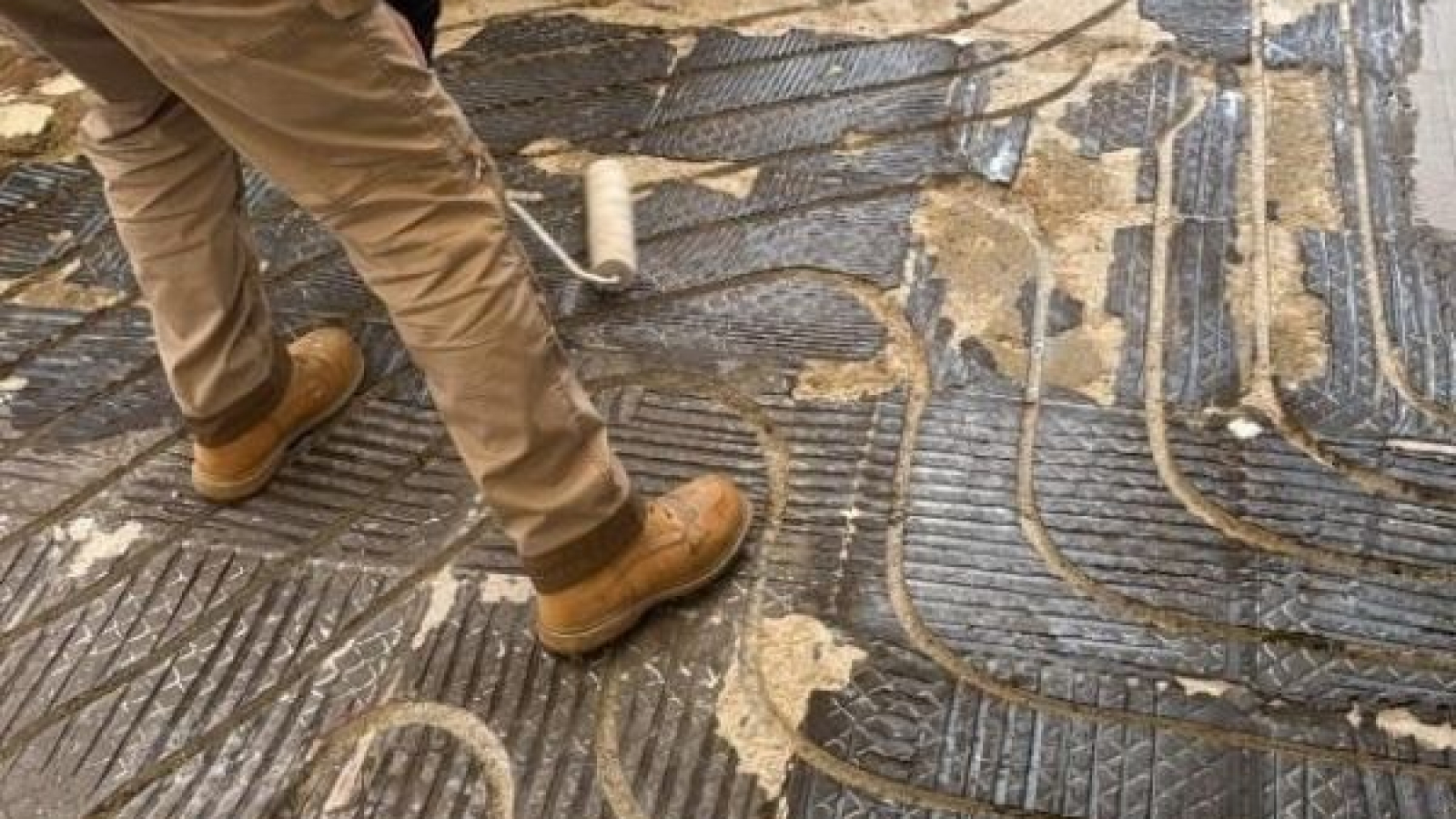
Retrofitting underfloor heating into a home with concrete floors has long been considered difficult or impractical. Traditional retrofits often meant breaking out the slab or adding multiple layers of insulation and screed – a disruptive, expensive process that dramatically changed floor levels.
Milling has changed the landscape of retrofit heating.
Using specialist machinery, engineers can create extremely accurate channels in an existing concrete or screed floor, allowing water underfloor heating pipes to be recessed neatly into the slab. This method delivers modern underfloor heating without raising floor levels or rebuilding the room from the ground up.
Below, we explore how milling actually works, why it delivers such strong heating performance, and when it’s the most suitable retrofit solution.
What milling actually involves (and why it’s so precise)
Concrete milling uses a high-torque, depth-controlled grinder to cut shallow, evenly spaced channels directly into the surface layer of the slab. Unlike traditional cutting tools, a milling machine removes material in a controlled pattern, ensuring:
- perfect pipe spacing,
- consistent depth,
- smooth channel curves, and
- minimal vibration or damage to the surrounding structure.
The depth is carefully calculated to ensure the pipes sit as close to the finished floor surface as possible, which is vital for fast heat transfer.
Once the channels are milled, pipes are clipped into place and the floor is sealed to create a stable, ready-for-finishing surface.
No new screed layers. No build-up. No structural changes.
The engineering reason milling works so well
Most traditional underfloor heating systems bury the pipework beneath 50–70 mm of screed. While this works in new builds, it creates a slow-responding thermal mass which means that heating takes longer to reach the room, and fine temperature control becomes harder.
With a milled system, the distance between the pipe and the floor finish is drastically reduced, often to single-digit millimetres.
This results in:
1. Lower heat-up times
The floor becomes warm noticeably faster which is ideal for lived-in homes where response time matters.
2. Lower flow temperatures
Because the pipes are close to the surface, heat doesn’t need to penetrate thick screed layers. The system can run at lower water temperatures – improving efficiency and perfectly complementing heat pumps.
3. More uniform heat distribution
The channels ensure accurate pipe spacing, which prevents hot/cold patches and creates a consistently warm surface.
Milling vs other retrofit methods
There are several retrofit UFH techniques, but each has trade-offs. Milling solves the biggest drawbacks found in other approaches.
Overboard systems
- Easy to install
– Adds 15–25 mm to floor height
– May require new doors, skirting, thresholds
– Slower heat-up due to boards and coverings
Low-profile screed systems
- Good for larger areas
– Adds new screed layer
– Requires curing time before use (weeks)
– Can add noticeable height
Full slab removal
- Allows for traditional UFH
– High cost and major disruption
– Not suitable in many existing homes
Milled systems (like the ones provided by Channel Heat Systems)
- No height increase
- Fast installation (usually 1–2 days)
- Works with most concrete and screed floors
- Immediate commissioning – no drying time
- Highly energy-efficient due to shallow pipe depth
- Minimal disruption or dust
For lived-in homes, milling is generally the least disruptive and most technically efficient retrofit option available today.
When milling is suitable (and when it isn’t)
Concrete milling is ideal for:
- ground-floor concrete slabs
- screeded extensions
- open-plan kitchens
- older homes with uninsulated floors
- rooms that feel cold despite radiators
- spaces where radiators limit furniture or layout
It may not be suitable if:
- the slab is extremely thin or structurally compromised
- the floor is not concrete or engineered screed
- moisture levels are excessively high
- the surface is heavily contaminated or unstable
This is why a proper technical assessment is essential before installation.
The importance of workmanship and system design
A milled system’s performance depends heavily on:
- channel spacing
- pipe bend radius
- depth tolerances
- manifold design
- flow temperature planning
- pressure testing
- zoning strategy
- insulation review beneath the slab (where applicable)
Poor-quality milling or design can reduce efficiency dramatically. This is where specialist experience matters.
At Channel Heat Systems, we use depth-calibrated milling equipment and design layouts tailored to each room’s heat loss. Every system is pressure-tested and commissioned so that it performs from day one.
Why homeowners choose milled underfloor heating
Clients typically choose milling because they want:
- underfloor heating without rebuilding their home
- a warm, comfortable space with no cold floors
- reduced heating bills through low-temperature operation
- a system compatible with both boilers and heat pumps
- a clean, modern solution with no radiators
And above all – a fast installation with very little disruption.
Most milled projects are completed in 1–2 days, and the heating can be used almost immediately.
Is milling right for your home?
For most concrete and screed floors, the answer is yes – milling is one of the smartest and most efficient ways to upgrade a heating system. But suitability depends on depth, condition and layout, which is why an assessment is essential.
If you’re planning a renovation or struggling with cold floors, this method may be the ideal solution.
Get a free assessment for your concrete floor
Our team specialises in precision-milled underfloor heating installations for both retrofit and new-build properties. We can evaluate your floor and tell you exactly what’s possible – no pressure, no obligation.