If you’ve ever considered underfloor heating but hesitated because you’re worried it’s expensive to run, you’re not alone. It’s one of the most common questions UK-based homeowners ask us, especially with rising energy costs.
The truth? When designed and installed properly, underfloor heating is one of the most efficient and cost-effective ways to heat your home.
Let’s break down why – and what really makes the difference.
1. Underfloor heating uses lower temperatures
Traditional radiators often run between 65–75°C, because they heat the air around them. Underfloor heating works differently as it radiates warmth evenly across your floor, gently heating the entire space.
Because of this, it only needs to run at 30–40°C to keep your home comfortably warm. That means your boiler or heat pump uses less energy to achieve the same comfort, lowering your energy bills.
2. Even heat = Greater efficiency
Radiators can leave you with hot and cold spots, leading to higher thermostat settings and wasted energy. In contrast, underfloor heating spreads warmth evenly, so you can set your thermostat lower and still feel perfectly warm.
That even heat distribution can reduce overall energy consumption by up to 25%, depending on insulation and usage.
3. The underfloor heating installation method matters
Not all underfloor systems are equally efficient. Traditional installation methods that add extra screed or build-up layers can trap heat and slow response times.
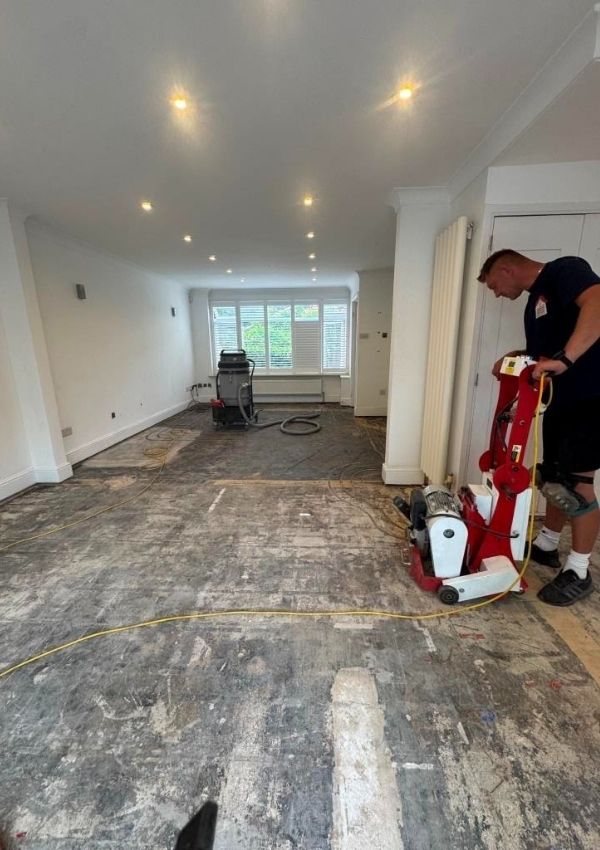
At Channel Heat Systems, we use precision floor-milling technology to cut clean, dust-free channels directly into your existing concrete or screed.
Our heating pipes sit just beneath the final floor finish, ensuring:
4. Pairing with modern heat sources to ensure maximum savings
Underfloor heating works perfectly with condensing boilers, but it truly shines when paired with heat pumps. This is because heat pumps operate most efficiently at lower water temperatures, combining the two can improve energy efficiency by 30–40% versus radiators.
That’s why so many homeowners choose underfloor heating when transitioning to renewable heating.
Heat pumps operate most efficiently at lower water temperatures. Combining the two can improve energy efficiency by 30–40% versus radiators.
So, what’s the real cost to run the underfloor heating?
The actual running cost depends on your home’s insulation, energy source, and control system, but generally, underfloor heating can be 15–25% cheaper to run than radiators.
In well-insulated homes, or when connected to a heat pump, the savings can be even higher. And because underfloor systems provide stable, gentle warmth, they avoid the “blast-and-cool” cycles that waste energy with traditional heating.
Underfloor heating can be 15–25% cheaper to run than radiators.
Final thoughts
So, is underfloor heating expensive to run? In most cases – absolutely not.
When installed correctly, it’s a low-temperature, high-comfort system that reduces waste, improves efficiency, and feels wonderful to live with.
Fully tested and commissioned for long-term reliability
Contact us to learn more or request your free quote!
Frequently Asked Questions
Does underfloor heating use more electricity than radiators?
No. In fact, it typically uses less energy overall because it runs at much lower water temperatures and spreads heat more evenly. If your system is powered by a heat pump, the efficiency gains are even greater.
Can underfloor heating be used with gas boilers?
Yes. Modern condensing gas boilers work very efficiently with underfloor heating because the lower return water temperature improves their performance.
Can I use it under any floor type?
Absolutely. Our systems work perfectly beneath tiles, engineered wood, vinyl, or laminate, as long as the flooring is compatible with radiant heat.
Is it worth installing underfloor heating in an existing home?
Yes, especially with our milled-floor retrofit method, which requires no floor height build-up and can be completed cleanly within 1–2 days.
How long does underfloor heating take to warm up?
Because our pipes sit directly beneath the final floor layer, you’ll usually feel warmth within 30–60 minutes, depending on the floor finish and insulation.
Does it require maintenance?
Very little. Once installed and pressure-tested, water underfloor heating systems require minimal maintenance and can last for decades with proper setup.
If you’ve ever mentioned wanting underfloor heating in your existing home, you’ve probably heard the objections: “Too disruptive.” “Too expensive.” “You’d need to rip up all your floors.” “It’ll take weeks.” “Your doors won’t fit anymore.”
For decades, these concerns were entirely valid. Retrofit underfloor heating genuinely was complicated, messy, and impractical for most occupied homes.
But technology has moved on dramatically – and most homeowners haven’t caught up with what’s now possible.
Modern retrofit underfloor heating, particularly for concrete floors, bears almost no resemblance to the disruptive process people imagine. What used to require weeks of major building work can now be completed professionally in 1-2 days, with your family staying in the house throughout.
Let’s separate the outdated assumptions from current reality and show you exactly what retrofit underfloor heating involves in 2025.
What is retrofit underfloor heating?
Retrofit underfloor heating means installing a water-based heating system into your existing property without major renovation work. Unlike new build installations where heating pipes are incorporated during construction, retrofit systems work with your home as it currently exists – finished floors, fitted kitchens, occupied rooms and all.
The key word is “retrofit” which effectively means adapting modern heating technology to fit existing structures rather than requiring complete floor reconstruction.
Why water underfloor heating for retrofits?
When discussing retrofit heating, we’re specifically talking about wet (water-based) systems rather than electric alternatives. Here’s why:
Running costs: Water systems operate at 35-45°C and typically cost £3-£5 per square metre annually to run. Electric systems require significantly more, around £10-£14 per square metre yearly.
Whole-home capability: Water systems connect to your existing heat source, making them practical and economical for large areas. Electric systems work well for small spaces like bathrooms but become prohibitively expensive for entire ground floors.
Heat pump compatibility: If you’re considering or already have a heat pump, water underfloor heating maximises efficiency by working at the low temperatures where heat pumps perform best.
Long-term value: Professional water systems typically last 25-50 years with minimal maintenance, whilst delivering consistent performance and genuine energy savings.
The traditional retrofit problem (and why it put people off)
To understand why modern retrofit is different, you need to know what made traditional installation so problematic.
Traditional retrofit underfloor heating required:
Complete floor removal: Lifting and disposing of existing floor coverings, subfloors, and often the screed beneath. This created enormous mess and required skips, disposal costs, and major disruption.
Significant floor build-up: Installing insulation boards (typically 50mm), pipes, and new screed (50-75mm) added 100-125mm to floor height. This cascaded into multiple problems:
Doors needed rehanging or replacing
Thresholds required adjustment throughout the house
Stairs might need modification
Kitchen units and fitted furniture became problematic
Period features and original proportions were compromised
Weeks of disruption: The process genuinely took 2-4 weeks per floor, during which rooms were completely unusable. Most families needed to move out temporarily.
Enormous cost: Labour costs alone for this level of work often exceeded £10,000-£15,000 for a typical ground floor, before materials.
These weren’t exaggerations or scare stories. Traditional retrofit underfloor heating genuinely was this disruptive and expensive. No wonder people assumed it was impossible for normal family homes.
How modern retrofit technology changed everything
The breakthrough came from precision engineering and specialised equipment that approaches the problem completely differently.
The modern retrofit underfloor heating approach: Introducing channel-cutting technology
Rather than building layers ON TOP of your existing floor, modern retrofit uses precision milling equipment to create channels directly INTO your concrete floor.
Here’s how it works:
Step 1: Floor assessment and design
Professional survey measures concrete thickness, identifies any embedded services, and calculates heat requirements for each room. Detailed pipe layouts are designed specifically for your space, accounting for heat loss areas, room shape, and usage patterns.
Step 2: Precision channel milling
Specialised grinding equipment cuts channels directly into your existing concrete or screed. These channels are milled to exact depth and spacing according to the design. Industrial dust extraction captures debris at source – typically 99%+ capture rate –keeping your home clean throughout.
Step 3: Pipe installation
Professional-grade pipes (we use 16mm for faster response times) are installed into the channels. They sit below your original floor level, not above it. Pipes are secured properly and the complete system is pressure-tested before any sealing occurs.
Step 4: Channel sealing and floor restoration
Channels are filled with specialised compound that bonds to the existing concrete. The floor surface is restored to its exact original level – not approximately, but precisely. Once set, the floor is ready for any covering you choose.
Step 5: System commissioning
Connection to your existing heat source, pressure testing, flow balancing, and professional commissioning ensure optimal performance from day one.
The dramatic differences this creates
Modern retrofit technology solves every major problem that made traditional installation impractical:
Zero floor height increase
Because pipes sit IN the floor rather than ON it, your floor level stays exactly where it is. This single factor eliminates dozens of complications:
Doors close perfectly – no modifications needed
Thresholds between rooms stay level
Kitchen units, fitted furniture – all unchanged
Period features and proportions preserved
Ceiling height fully maintained
This makes retrofit possible in properties where traditional methods simply couldn’t work: Victorian terraces with tight door clearances, Edwardian homes with original features, any property where floor height cannot change.
1-2 day installation timeline
Professional retrofit installations typically complete within 1-2 days for most residential projects. Not weeks. Days.
Day 1: Equipment arrival, channel cutting, pipe installation, pressure testing
Day 2: System connection, commissioning, floor restoration
Your rooms are walkable within hours of completion. The entire process happens whilst you remain in your home, using other rooms normally.
Minimal disruption and mess
Industrial dust extraction systems capture debris at source during channel cutting. Protective coverings shield furniture and adjacent spaces. Professional teams work cleanly and methodically.
The difference between modern retrofit and traditional installation is stark: instead of living in a building site for weeks, you experience manageable disruption measured in hours rather than days.
Dramatically lower cost
Modern retrofit installation costs are a fraction of traditional methods. Without weeks of labour, floor removal, disposal costs, and major building work, the financial barrier drops substantially.
For properties with concrete floors, retrofit underfloor heating now costs broadly similar to complete radiator system replacement, making it a realistic consideration rather than an impossible luxury.
Is your property suitable for retrofit underfloor heating?
Not every home is an ideal candidate, but many more are suitable than most people realise.
Here’s what matters:
Ideal properties for modern retrofit:
Concrete or screed floors: The channel-cutting approach works beautifully with solid floors. Most UK properties built from the 1930s onwards have ground floor concrete construction making them perfect for this method.
Adequate floor depth: Channels typically require 75-100mm total floor depth (concrete plus screed) for safe milling. Most residential floors exceed this comfortably, but we verify during assessment.
Ground floor areas: Living rooms, kitchens, hallways, conservatories, and extensions benefit most from underfloor heating. These are typically the spaces with concrete construction.
Properties with tight clearances: Ironically, homes where traditional methods couldn’t work such as Victorian and Edwardian properties with minimal door clearances are often perfect candidates for modern retrofit because zero floor height increase solves the constraint completely.
Renovation projects: If you’re already renovating kitchens, bathrooms, or extensions, retrofit underfloor heating integrates perfectly into the project timeline and budget.
Properties requiring alternative approaches:
Suspended timber floors: Upper floors with timber joists require different techniques, either between-joist installation or overlay systems. These are viable but involve different considerations.
Very thin screed: Some properties have minimal screed depth that makes channel milling impractical. Alternative systems exist but costs increase.
Listed buildings: Conservation requirements may limit options or require specific approvals, though modern retrofit often qualifies precisely because it preserves original features and floor levels.
Properties with underfloor services: Extensive pipework or cables in screed (less common in older properties) may complicate channel routing. Professional assessment identifies these situations.
Common retrofit underfloor heating concerns addressed
“Will it work with my existing boiler?”
Most modern boilers work perfectly well with underfloor heating. The system operates at lower temperatures than radiators, which is actually easier on your boiler and more efficient.
Older boilers may need a mixing valve to ensure water temperature stays optimal. We assess compatibility during the free survey and advise honestly about whether any modifications are needed.
If you’re considering boiler replacement anyway, combining the projects makes excellent sense as pairing underfloor heating with a heat pump delivers maximum efficiency and government grant eligibility.
“What about leaks – can pipes be accessed?”
Modern pipe materials and professional installation make leaks extremely rare. Quality pipes with proper pressure testing before sealing virtually eliminate this risk.
In the unlikely event of a leak, we provide detailed as-laid diagrams showing exact pipe locations. Repairs involve accessing the specific affected area only, not ripping up entire floors. This is why documentation and professional installation matter so much.
Most professional installations include warranties covering materials and workmanship for multiple years, providing peace of mind.
“Won’t it take ages to heat up?”
This depends entirely on pipe diameter and system design. Many retrofit installations use standard 12mm pipes that genuinely do take 2-3 hours to heat rooms – this is a valid concern with poorly designed systems.
We use 16mm pipes specifically to address this issue. The larger diameter provides 33% better water flow, delivering warmth within 30-60 minutes rather than hours. This makes retrofit underfloor heating as responsive as radiators whilst maintaining all the efficiency benefits.
Proper system design, sizing, and commissioning ensure quick response times rather than the sluggish performance that gives underfloor heating an undeserved reputation for being slow.
Choosing the right retrofit underfloor heating installer
The quality of your retrofit installation depends entirely on installer expertise and equipment. This isn’t a job for general builders or heating engineers without specific retrofit experience.
What to look for:
Specialised equipment: Channel-cutting requires professional-grade grinding equipment with industrial dust extraction. Installers using basic angle grinders cannot achieve the precision or cleanliness professional retrofit demands.
Retrofit experience: Ask for examples of completed retrofit projects in properties similar to yours. Period properties, tight clearances, occupied homes – these require specific expertise.
Transparent pricing: Detailed quotations with clear breakdowns. No hidden costs or “additional work discovered” charges. Fixed pricing that doesn’t change once work begins.
Professional design: Room-by-room heat calculations, pipe layouts optimized for your space, proper zoning and controls. Not generic “standard layouts” that ignore your property’s specifics.
Comprehensive service: Survey, design, installation, pressure testing, commissioning, documentation, and warranty. Professional retrofit includes all these elements as standard.
Ready to explore retrofit underfloor heating for your property?
We offer free, no-obligation assessments for UK homeowners considering retrofit underfloor heating:
What you’ll receive:
Professional property survey and floor evaluation
Heat loss calculations and system design recommendations
Transparent pricing with complete cost breakdown
Honest advice about whether retrofit makes sense for your specific situation
No pressure to proceed, just expert guidance!
Get a free assessment today: 📞 0203 9166 264
📱 +44 7951 041911
📧 info@channelheatsystems.co.uk
Professional retrofit underfloor heating installation across the UK – specialised equipment, transparent pricing, rapid installation, proven results.