
One of the biggest concerns we hear from homeowners planning a renovation and debating retrofit underfloor heating is:
“We’ve been told underfloor heating won’t work unless we dig up the entire floor and install insulation. Is that true?”
It’s a fair question, and one that’s often answered with a simple “yes” or “no”.
The reality is more nuanced.
If you’re building a new home, the answer is straightforward. Insulation beneath the slab is best practice and something we’d always recommend. It improves the overall efficiency of the building and forms an important part of modern construction.
But most of the projects we work on aren’t new builds.
They’re existing homes, kitchen extensions and renovation projects where excavating the entire ground floor simply isn’t practical.
So does that automatically mean retrofit underfloor heating isn’t worth considering?
From our experience, absolutely not.
Does underfloor heating need insulation?
Let’s start with the fundamentals.
Insulation benefits every heating system, whether your home is heated by radiators or underfloor heating. A well-insulated property retains heat more effectively, requires less energy to maintain comfortable temperatures and generally performs better overall.
If you’re building a new home or replacing the floor from the ground up, we’d always recommend installing insulation beneath the slab. It’s the right approach, supports modern Building Regulations and gives the heating system the best possible foundation.
There’s no debate there.
The question becomes much more complex when you’re renovating an existing property.
Why existing homes present a different challenge for retrofit underfloor heating?
Many UK homes were built decades before today’s insulation standards existed.
Victorian terraces. 1930s semis. Post-war properties. Older bungalows. Extensions built at different times.
If you’re renovating one of these homes, adding insulation beneath the slab isn’t always as simple as laying a few boards.
It can involve removing the existing screed, excavating the floor, lowering the sub-base, relocating services and rebuilding the floor construction from scratch.
For many homeowners, that transforms what should be a heating upgrade into a major structural project.
And in many cases, it simply isn’t necessary.
Does that mean underfloor heating won’t work?
No, not at all.
This is where online advice often becomes too black and white.
From our experience installing retrofit underfloor heating across existing homes throughout the UK, we’ve completed many projects where installing insulation beneath the slab simply wasn’t practical.
Yet homeowners consistently tell us the same things afterwards:
- The room feels warmer and more comfortable.
- Cold spots have disappeared.
- The temperature feels more even throughout the space.
- Their extension finally feels like part of the house rather than a colder room.
That’s because comfort isn’t determined by one factor alone.
A heating system should always be looked at as a whole.
“But won’t all the heat disappear into the floor?”
This is probably the biggest myth surrounding retrofit underfloor heating.
The truth is that every heating system loses heat.
Whether your home is heated by radiators or underfloor heating, warmth will always escape somewhere.
In many homes, the biggest areas of heat loss are actually:
- Windows and glazing
- Roofs and loft spaces
- Draughts and air leakage
- Poorly insulated external walls
- Thermal bridges
Interestingly, UK homeowners are rarely told their house is “unsuitable” for radiators because of these losses.
Yet when underfloor heating is mentioned, the conversation often focuses solely on heat travelling downward.
Of course, some heat will always move downwards – that’s simply how heat behaves.
But in our experience, it’s often far less significant than many people imagine.
Why retrofit underfloor heating performs differently
One of the biggest advantages of Channel Heat Systems retrofit system is how it’s installed.
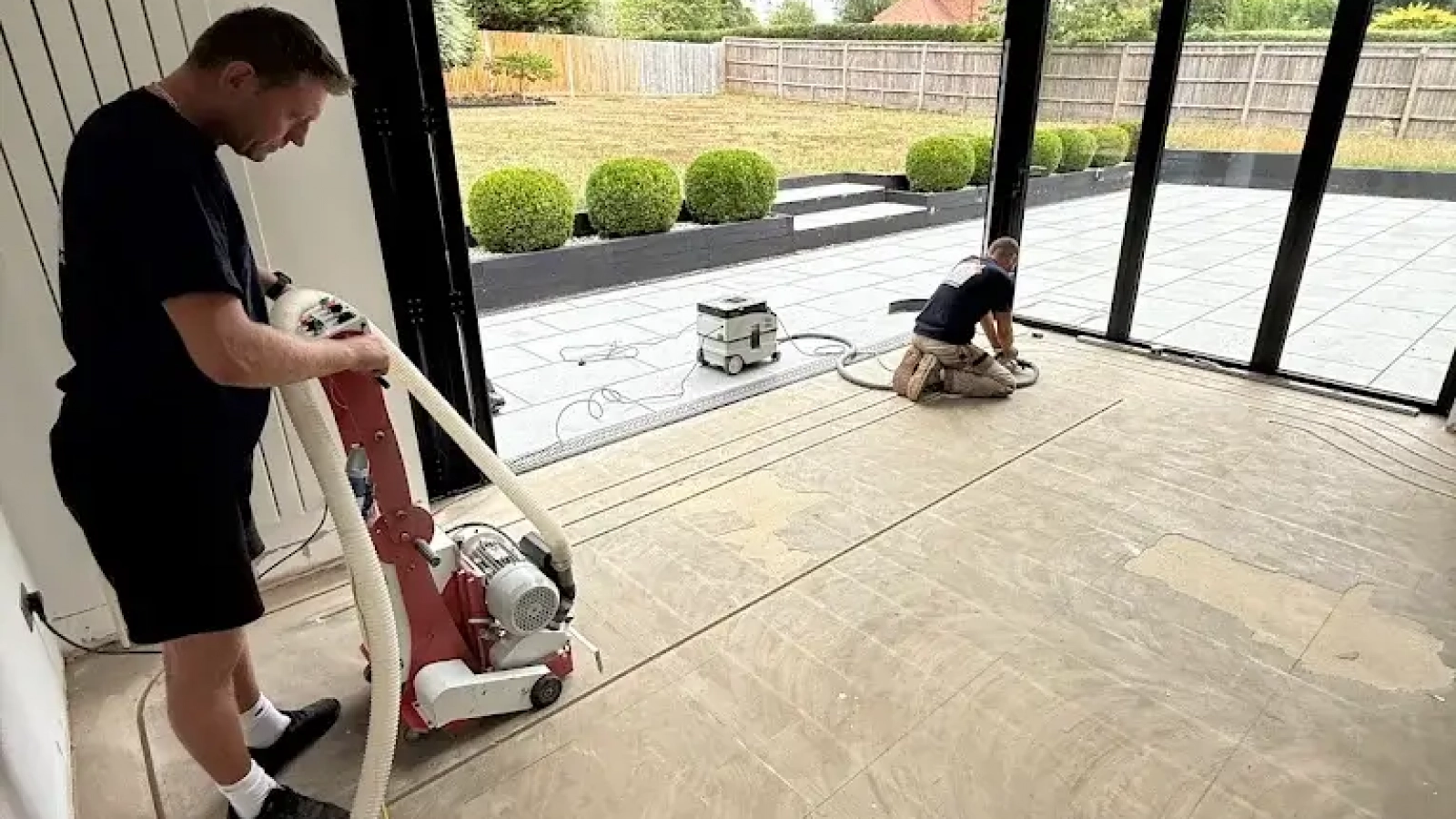
Rather than laying thick insulation boards or overlay panels on top of the existing floor, we precision mill channels directly into the existing screed or concrete.
The pipework sits just beneath the self-levelling compound and close to the finished floor surface.
This means the warmth has a much shorter distance to travel before reaching the room.
Compared to traditional deep screed systems, homeowners often notice much faster response times, with warmth becoming noticeable within around 20–30 minutes in many installations.
That doesn’t eliminate heat loss entirely – unfortunately, no heating system can.
But it does mean the heat is delivered where it’s needed more quickly, while also providing the even, radiant warmth that underfloor heating is known for.
It’s about more than insulation
Heating performance depends on many factors working together.
These include:
- Floor construction
- Pipe positioning
- Flow temperatures
- Floor finish
- Heating controls
- The overall design of the system
- The insulation levels throughout the property
That’s why two houses with similar insulation can perform very differently if the heating system hasn’t been designed correctly.
Likewise, two older properties without perfect insulation can deliver excellent comfort when the system is properly specified.
Every property is different
One of the reasons we avoid giving blanket answers is because every project is different.
When assessing a property, we look at:
- Existing screed or concrete floors
- Suspended timber floors
- Planned renovations or extensions
- Existing heating system
- Heat pump or boiler compatibility
- Floor finishes
- Overall project goals
Only then can we recommend the most appropriate solution.
So… Does retrofit underfloor heating need insulation?
If you’re building a new home, absolutely. Insulating beneath the slab is best practice and something we’d always recommend.
But if you’re renovating an existing property, the answer is more nuanced.
The absence of perfect insulation doesn’t automatically mean retrofit underfloor heating isn’t the right choice.
In our experience, many homeowners still achieve outstanding comfort, excellent heat distribution and a significantly improved living environment, even when installing insulation beneath the slab simply isn’t practical.
Every home is different.
And that’s exactly why every project deserves an individual assessment rather than a one-size-fits-all answer.
Thinking about retrofit underfloor heating?
Whether you’re renovating an older property, extending your home or replacing existing flooring, we’re happy to provide honest advice based on your project, not generic assumptions.
At Channel Heat Systems, we specialise in retrofit underfloor heating for existing homes, using precision floor milling to install warm water underfloor heating directly into existing screed and concrete floors with minimal disruption and minimal floor build-up.
Send us your floor plans, and we’ll provide an initial assessment of what’s possible for your home!